
How many nights do you actually need to book to profit?
Your break-even is your fixed monthly costs divided by what you keep from each night after the platform's 15.5% host fee. This ledger works it out for each season; nothing you enter leaves your browser.
Sample property Every number below is an example. Type over them before you trust the totals.
High season
Your busiest, best-paid months.
$
What guests pay per night in your busiest months.
of 30
One rate all year? Enter 12 here.
Fixed costs, every month
$
$
$
$
Low season
The slower months at your off-peak rate.
$
Often 40–60% below your high-season rate.
of 30
Fees and tax
%
%
15.5% is Airbnb's host-only fee. Use your own platform's rate if you list elsewhere.
Leave the manager's cut at 0 if you self-manage.
%
Federal plus state, on your top dollar of income. Only used for the after-tax line.
Cleaning, if you charge for it
$
$
nights
Cleaning is paid once per stay, so the margin is spread over the nights of a typical stay. The platform fee applies to your cleaning charge too.
Year +$8 ahead for the year, before tax
After an estimated 24% tax: +$6
What closes the gap
High season
Low season
Show the math
| Fixed costs | |
|---|---|
| What you keep per night, high season | |
| What you keep per night, low season | |
| Cleaning margin | |
| Break-even, high season | |
| Break-even, low season | |
| Occupancy, high season | |
| Occupancy, low season | |
| Profit, high season | |
| Profit, low season | |
| Year, before tax | |
| Year, after estimated tax |
Your cash position, month by month
Running total, high-season months (H) first, then low (L).
An educational estimate from the numbers you entered. It leaves out vacancy risk, major repairs, one-time startup costs, and whether you file on Schedule C or Schedule E. Our pricing and tax guide covers those; a CPA should confirm your filing.
The HostTally Profit Toolkit
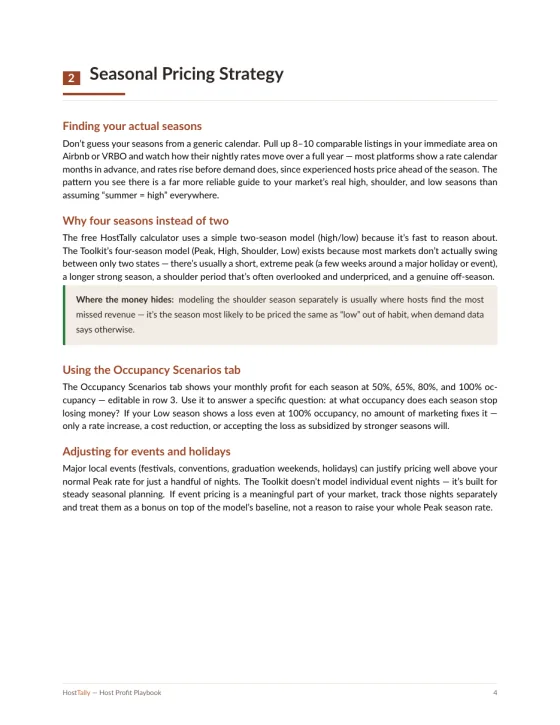
Chapter 2 of the Playbook, Seasonal Pricing Strategy, is about closing a losing season's gap.
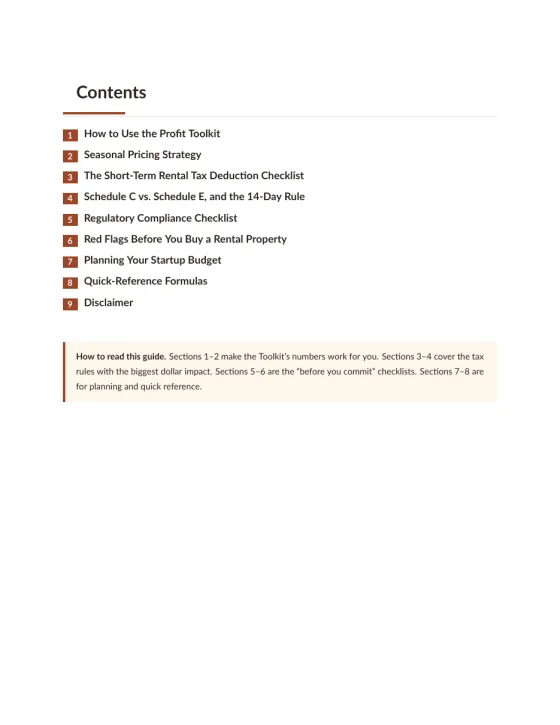
- The Host Profit Playbook, an 11-page PDF: seasonal pricing strategy, the 2026 tax deduction checklist, Schedule C vs. Schedule E and the 14-day rule, a compliance checklist, and red flags to check before you buy.
- The Profit Toolkit spreadsheet (XLSX): 12-month cash flow, mortgage amortization, occupancy scenarios, depreciation, and your total return.
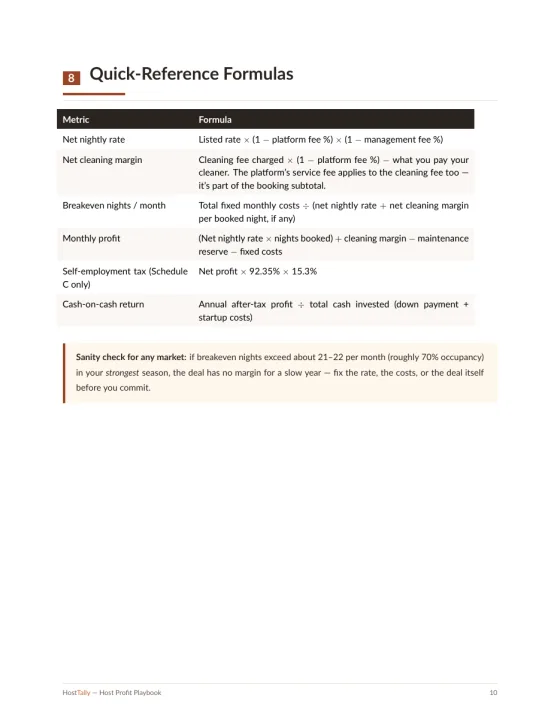
Real pages from the Playbook: Seasonal Pricing Strategy in front, the contents and the formula sheet behind it.
$39 one time, instant download
Get the Toolkit for $39Written by Dee Byrd, founder of HostTally. Secure checkout through Stripe; your download link appears right after payment. Questions or trouble with a download? Email support@hosttally.com.
Why most hosts don't know their real break-even
Most new hosts copy what nearby listings charge instead of working out what they need to earn.
- Fees quietly take 15–25% of revenue. Between the platform's host fee, the cleaning pass-through and a manager's cut, your nightly rate and what you keep per night can be very different numbers.
- Seasonality hides the real math. A strong summer can mask a losing winter. Few hosts check whether the slow months pay for themselves.
- Taxes come up too late. Schedule C or Schedule E, and whether the 14-day rule applies, change your real return more than most hosts expect.
Short-term rental profit: common questions
How many nights do I need to book to break even on a short-term rental?
Divide your total fixed monthly costs (mortgage or rent, insurance, utilities, HOA) by your net nightly rate: your nightly rate after the platform's service fee and any management fee, plus any profit margin on your cleaning fee. For example, with $2,140 in fixed monthly costs and a $200 nightly rate that nets about $169 after Airbnb's 15.5% host fee, you need roughly 13 booked nights per month to break even. Most hosts need a different number in high season than low season, which is why the ledger above works out both.
What is a breakeven night for an Airbnb or vacation rental?
Your breakeven night count is the number of booked nights per month at which rental revenue exactly covers your fixed costs. Every booked night beyond it is profit; every night short of it is a loss you cover out of pocket. It's the single most important number for judging whether a rental works in its slow season.
How much does Airbnb take from hosts in 2026?
As of April 13, 2026, Airbnb charges most hosts a single host-only service fee of 15.5% of the booking subtotal. The subtotal includes your nightly rate, your cleaning fee, and any extra guest fees, so the fee applies to your cleaning charge too, not just the nightly rate.
Does Airbnb's service fee apply to cleaning fees?
Yes. The host service fee is charged on the full booking subtotal, which includes the cleaning fee. If you charge guests exactly what your cleaner costs, you lose a little on every stay. To break even on cleaning, your charge needs to exceed your cleaner's cost by at least the platform fee percentage. The ledger above accounts for this.
Will I get a 1099-K for my rental income in 2026?
For tax year 2026, the federal 1099-K reporting threshold is $20,000 in gross payments and more than 200 transactions (the earlier $600 threshold was repealed in July 2025). Some states set lower thresholds, and your rental income is taxable whether or not you receive a 1099-K. Ask a CPA whether Schedule C or Schedule E applies to you; our pricing and tax guide explains the difference.
Is the HostTally calculator free, and what happens to my numbers?
It's free, with no login or signup. Every calculation runs in your browser and nothing you enter is sent to or stored on any server; you can check this in your browser's network tab. HostTally makes money from the optional $39 Profit Toolkit, not from your data.
What this calculator does, and doesn't
It does
Add up your monthly fixed costs, net your nightly rates against platform and management fees, and show the nights per season you need to break even, plus a before- and after-tax estimate for the year.
It doesn't
File your taxes, replace a CPA, price your listing day to day, or cover one-time costs like furnishing, major repairs, or a slow first year while you build reviews.
Your data
Everything you type stays in your browser. Nothing is transmitted or stored, and the site runs no analytics or tracking scripts.
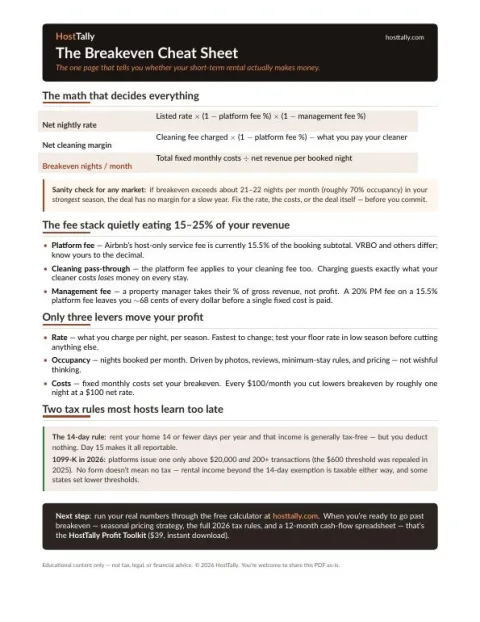
Take the one-page Breakeven Cheat Sheet with you
The three levers that move your break-even, the fee stack, and the two tax rules hosts learn too late, on one page.
Want to keep your numbers too? . The numbers live in the link itself; our server never sees them.